

What Makes a Country Christian
May 12, 2025Identifying as Christian is not the same thing as a truly Christian identity.
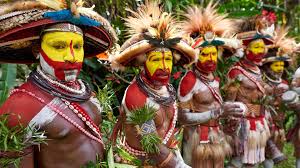
Papua New Guinea is now officially a Christian country.
On March 12, 2025, PNG’s parliament voted 80 to 4 to amend the nation’s constitution to formally declare its Christian identity. New wording in the preamble will recognize “God, the Father; Jesus Christ, the Son; and Holy Spirit, as our Creator and Sustainer of the entire universe and the source of our powers and authorities.” What’s more, the Bible will be officially recognized as a national symbol. Religious freedom is still a priority, so no one will be punished for adhering to any other faith, but the clear favorite is Christianity when it comes to religion in Papua New Guinea.
Denominationally, Roman Catholicism is the most prevalent form of Christianity in PNG, followed by Evangelical Lutherans and Seventh-Day Adventists. Pentecostal churches make up about 10 percent of established churches. Other evangelical churches comprise a smaller percentage.
Christianity was first introduced to the island nation in 1871 by British missionaries. As was typical during the missionary movements of the late 19th century, Christians played a major role in developing education and healthcare while also paralleling and at times facilitating European colonial expansionism. Also typical was the adoption of certain Christian principles by local populations who were simultaneously committed to maintaining their traditional religions, resulting in a kind of syncretism where biblical teachings coexisted with ancestral customs, rituals, and symbols.
I think it’s a good thing overall for a country to declare itself Christian by identity if not by governance. PNG is not a theocracy, but most citizens are Christians of some kind, and I think it’s fine for the government to formally acknowledge this fact. But declaring yourself to be a Christian country does not bring salvation, and it doesn’t necessarily make anyone’s life better either. The Bible is clear that salvation comes only through Jesus, and true Christian flourishing takes place when people live like Christ, not when they identify as Christians.
At Tyndale House Foundation, we are intentional about partnering with organizations that operate across multiple dimensions of evangelical Christianity within cultures. Our five grantmaking categories reflect our commitment to building and supporting flourishing Christian communities. We believe it’s not enough for there to be evangelism and church planting taking place if there isn’t also theological education and pastor training to support churches and believers. That’s why Education is a category for us along with Discipleship. Gospel proclamation is essential, but so is humanitarian relief, and so we prioritize Compassion grants as well. Leadership development is necessary for long-term sustainability, so Training is a significant value for us. And because Tyndale is also a publisher founded out of a desire to make God’s Word understandable for everyone, we fund Bible translation (including in Papua New Guinea) as part of our commitment to encouraging indigenous Christian publishing in our Literature category.
Many of these building blocks comprising a flourishing Christian culture exist in PNG, but there’s still work to be done. I hope the parliament recognizes this and will take steps to encourage the development of seminaries to pursue solid theological education along with institutions that promote the other components of an evangelical culture.
The fact that Papua New Guinea is officially identifying itself as a Christian country just 150 years after the first missionaries arrived there is an encouraging example of the Great Commission in action. Now I’m eager to see the cultural impact of biblical teaching and genuine, personal relationships with Christ that transcend cultural Christian identify. And I’m excited to continue investigating how Tyndale can help.
Here’s what’s happening.
European Leaders Gathering in Poland
Next week, the 2025 European Leadership Forum (ELF) will kick off in Wisla, Poland. Almost a thousand evangelical leaders from every European country will come together for fellowship, worship, training, encouragement, mentoring, strategy, and hopefully some fun. Since 2003, ELF has been uniting, equipping, and resourcing Christian leaders throughout Europe with the tools they need to strengthen the European church and bring the gospel back to what is largely a post-Christian continent. I’ve often said there is no more strategic way to invest in ministry in Europe than through ELF, and I’m excited to once again be going and speaking in a couple of workshops in addition to having dozens of meetings with existing and potential partners. One of the reasons ELF is so strategic is that it brings so many leaders together in the same place, so it’s easy to meet with lots of amazing people in a short period of time. However, believe it or not, ELF doesn’t exist primarily to offer a convenient place for American foundation leaders to conduct meetings. The real reason ELF is so impactful is the quality of the Christian leaders who attend. There are some very exciting things happening in Europe in, for example, church revitalization, apologetics, theological education, church planting, scientific and scholarly engagement, and more. THF has partners operating in all of these areas, and the good work they’re doing would likely not be happening without ELF as a resource. Please pray for the leaders traveling to Poland early next week and for tremendous gospel impact to result from the time together.
Movement Leaders Meet in Cyprus
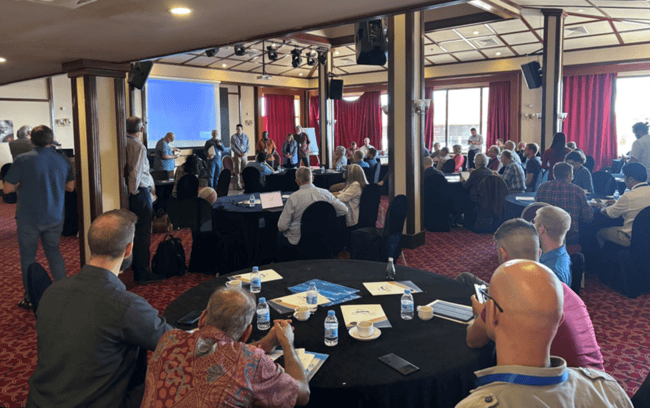
Last week, THF chair Becky Wilson was in Cyprus along with dozens of other mission leaders focusing on movement methodology. This conference was convened by a THF partner network called Motus Dei, which is Latin for “movement of God.” Participants at the gathering included prominent movement authors, church-planting practitioners, and church-movement leaders from around the world. What is movement methodology? You may be familiar with concepts like Church Planting Movements (CPM), Disciple Making Movements (DMM), Discovery Bible Studies (DBS), etc. The main idea behind these kinds of practices is that by focusing on ordinary believers making disciples who make more disciples, new churches can be created very rapidly, making a significant impact within a culture. Movement practitioners advocate for the multiplication of obedient disciples through discovery-based, Spirit-led engagement with Scripture that isn’t dependent on professional clergy or missionaries or centralized programs. The concept is not without controversy, as some in the mission world are unconvinced about the long-term effectiveness of these kinds of practices. But when you consider the fact that there are more people in the world today who have never heard about Jesus than ever before in history, it does seem that the way to effectively engage the Great Commission is for the gospel to essentially go viral, and the way that happens is through multiplication. At THF, we champion both movement-based and more traditional approaches to church planting, and we’re always on the lookout for reputable partners doing either or both. Whether or not you’re personally excited about movement methodology, the reality is that hundreds of thousands of new house churches will be formed in the coming years through CPM and DMM methods. Please pray that these churches will be properly equipped to thrive as members of the ever-expanding global body of Christ.

Trend Analysis Part 2
During the month of May, I’m using one segment of the THF Weekly briefing each week to describe and analyze a trend we’re seeing in the world of philanthropy. Last week I talked about Trust Based Philanthropy. This week’s trend is Celebrity Philanthropy—which is fitting in light of Bill Gates’s recent announcement that he now plans to give away almost all of his massive fortune within the next 20 years. What are others doing? A recent article from the Center for Effective Philanthropy stated, “Research shows Mackenzie Scott’s large, unrestricted gifts create sustained impact for nonprofits and communities.” Much has been made of Warren Buffet’s “Giving Pledge,” a commitment to donate 99 percent of his wealth during his lifetime. People look askance at billionaires like Jeff Bezos and Elon Musk when it seems like they aren’t being generous enough. In general, we seem to be okay with people being rich as long as they’re magnanimous with their wealth. What does the trend mean? Scholars have literally written dissertations on Mackenzie Scott’s philanthropy. Doctorates have been awarded for research into her method of giving and the impact that comes from it. The problem from my perspective is that Ms. Scott’s strategy seems to consist entirely of giving huge grants to organizations that share her political ideals. She doesn’t have a board to advise her; she doesn’t receive proposals; her giving is not guided by biblical principles of generosity but rather by secular social ideals. What is THF doing? We obviously are not anywhere near the same universe as Scott, Buffet, and Gates when it comes to the amount of dollars given away annually. But I would argue that they’re not in the same universe as us when it comes to intentionality. The THF board carefully reviews every proposal; every grant fits into one of six grantmaking categories that align with our mission and mandate; we operate according to biblical principles of generosity and partnership; we partner with organizations operating across multiple dimensions of a flourishing Christian culture as described above. No one is writing dissertations about THF’s strategy (yet), and we don’t have celebrities on our board, but we are carrying on our founders’ legacy of radical generosity and serving the Global Church in the process.
From the Bookshelf
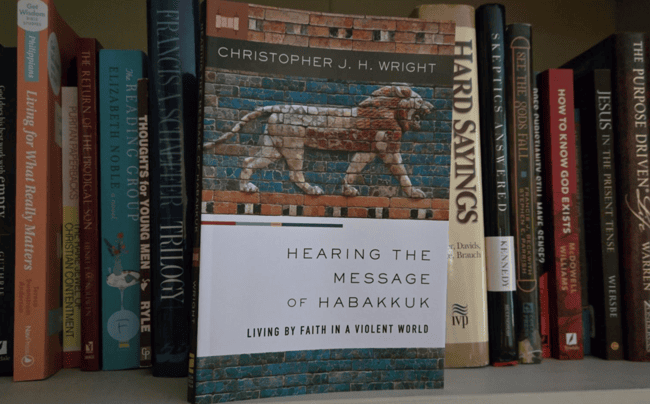
Do you ever look around at everything that’s happening in the world and find yourself wondering just exactly what God is up to? Why is an unjust war in Ukraine still raging after three years? Why do rich people who have no interest in spiritual things keep getting richer while poor Christians in the Majority World struggle to survive day to day? Why is religious persecution on the rise in places like Nigeria and India? Why doesn’t God intervene? These are exactly the kinds of questions asked by the ancient prophet Habakkuk as he observed the incursion of the Babylonian Empire into Israel, and theologian Christopher J. H. Wright offers an excellent exposition of Habakkuk in his new book Hearing the Message of Habakkuk: Living by Faith in a Violent World. I’ve been a fan of Chris Wright for a long time, and I happily read anything he writes. But I found this book to be particularly helpful in understanding what the Bible says about how Christians can understand and engage with injustice in today’s world. Much of foundation work is fun and brings joy, but it’s difficult when our partners are facing massive problems. Our relational approach to grantmaking brings us into close proximity with conflict and pain as we pray for and weep with our partners who are struggling. Habakkuk’s questions—and God’s answers—are a comfort in a world that seems increasingly out of control. This book by Chris Wright is short and accessible, and I commend it to you if you can identify with Habakkuk’s bewilderment at the state of the world.
That’s it for this week’s briefing. Please send any questions, comments, and ideas for new three-letter acronyms (TLAs) for movement methodology to [email protected]. I send out this email resource most weeks primarily for a Tyndale audience, but you should feel free to share it with others who may be interested, inside or outside of Tyndale. Thanks for continuing to pray for and support our partners around the world.
Jeremy Taylor
President | Tyndale House Foundation
The THF Weekly Briefing provides information about significant events happening in the wide universe of Tyndale House Foundation partner organizations as well as an occasional peek behind the scenes of THF’s operations. It is available to anyone at Tyndale who’s interested in learning more about the Foundation side of the organization. Was this email forwarded to you? Contact [email protected] to be added to (or removed from) the distribution list.