


In Pursuit of Context
May 21, 2025Incomplete messages distort meaning.
“In the spring, a young man’s fancy.”
That’s what I said when I saw my 17-year-old son all decked out for his high school prom. He was wearing a dark suit, white shirt with no tie, and shiny new shoes. He looked amazing—very fancy indeed.
That line, penned in 1838 by Alfred, Lord Tennyson, is probably the most well-known and most recognizable line from his lyrical poem “Locksley Hall.” There’s just one problem—the line is incomplete.
Here it is in context:
In the Spring a fuller crimson comes upon the robin’s breast;
In the Spring the wanton lapwing gets himself another crest;
In the Spring a livelier iris changes on the burnish’d dove;
In the Spring a young man’s fancy lightly turns to thoughts of love.
It turns out he’s not talking about young men looking fancy in the spring; he’s saying that romance is as natural a part of spring as the physical changes birds undergo when mating season comes around. Knowing the whole line is essential to understanding it. Incomplete messages distort meaning.
Here’s another example of the same phenomenon. James 4:2 concludes, “You don’t have what you want because you don’t ask God for it.” I like the King James: “Ye have not, because ye ask not.” What an encouraging verse! All we have to do is ask, and God will give us the desires of our heart. The only reason we don’t yet have what we want is that we haven’t asked for it. Right?
Not so fast. Again, there’s a problem—the verse is incomplete. This sentence comes at the end of a longer passage that talks about improper desires as the basis of dissention among believers, and then verse 3 continues, “And even when you ask, you don’t get it because your motives are all wrong—you want only what will give you pleasure.”
The full context reveals a very different meaning from the implication about getting whatever we want from God suggested by the partial passage.
Context matters!
That’s true in reading, and it’s true in assessing ministry organizations as well. If you only have access to a single report or one leader’s perspective, you’re not going to get the full picture of what’s going on. I recently read a report from a THF partner organization involved in Bible translation. According to the report, more than 80 percent of the world’s population now has access to the Bible in their own language. That’s great progress, but it’s less encouraging in the context of statistics from China Christian Daily stating that even if they have Scripture in their language, 76 percent of Asian people know nothing about the Bible and 56 percent have never even heard of it! Bible translation is nearing an exciting finish line, but the need for Bible engagement has never been bigger. Understanding the larger context helps us know how to pray, how to partner, and where to give.
This is the reason making connections between organizations is one of the most important things we do at Tyndale House Foundation, and it’s the reason we spend so much time meeting with partners. Every ministry organization in the world needs money, but they often need context even more urgently. If we can connect people in a way that helps them—and us—understand the whole picture of what’s going on in a particular region or ministry area, we’ll be helping in a way that’s much more valuable than a grant.
Here’s what’s happening.
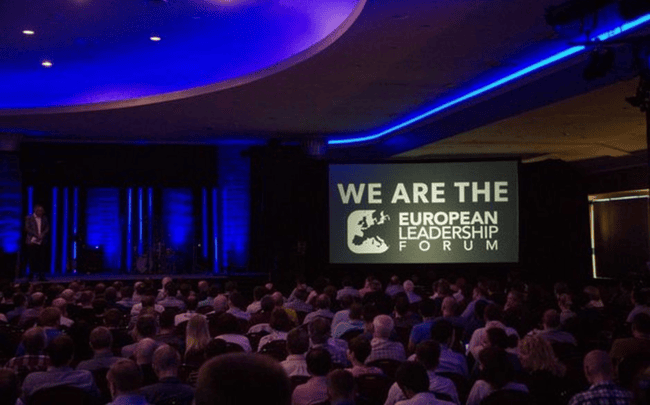
God at Work in Europe
This week I’m in Poland at the European Leadership Forum. My responsibilities include teaching a workshop about fundraising alongside two other foundation leaders and speaking about generosity at a gathering of Forum supporters and stakeholders. But mostly what I’m here to do is meet with partners. I had more than 20 meetings arranged weeks ago, and I keep running into more people here that I want to meet with as well, so my meeting slots are getting extended into the late-night hours. This is one of the reasons I view ELF as so strategic, because I can get in-person updates on ways God is moving all across the continent (and, increasingly, around the world) without having to visit dozens of different countries. Here’s just a taste of what I’m learning:
- A former Romanian government official is operating a housing center for displaced Ukrainian children and raising money to create waterproof Bibles for Ukrainian soldiers.
- Jewish and Arab believers in Israel are working together on university campuses to model reconciliation and bring healing even as the war still rages in Gaza.
- Three different Czech publishers are starting to see interest in Christian literature increasing in the world’s most atheistic country.
- A youth ministry in Hungary is thriving under new leadership and equipping youth workers to reach more Hungarian young people.
- Theological education is advancing through church-based learning groups in contexts where it would be impossible for students to attend classes at a formal campus—places like Italy and Greece and as far away as Zambia and Madagascar.
Praise God for what he’s doing through these and many other partners I’ve had the privilege of spending time with this week.
Multiplying Impact
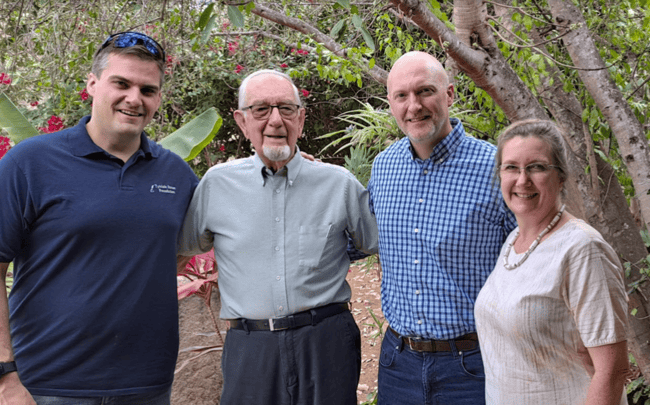
In 1967, an American missionary named Don Smith and his colleague Motsoko Pheko launched Daystar Communications in Bulawayo, Zimbabwe. Their vision was to train African Christians to be salt and light not only in churches but in radio stations, newspapers, classrooms, and public service. Within a few years, however, political instability and educational limitations in Zimbabwe forced Daystar to look for a new home. When he heard about the need to relocate, Ken Taylor told Don that Tyndale House Foundation would provide a grant of $100,000 to purchase and develop a plot of land in Nairobi, Kenya. After moving to the new location, Daystar eventually expanded into a full-fledged university and today is the largest liberal-arts college in Africa. Don Smith, who still lives in Kenya, credits this grant from Tyndale as a significant reason Daystar was able to get off the ground in the early days. But that’s not quite the whole story—the gift was originally intended as a matching grant to encourage Daystar to find other donors. When the school was not able to raise the amount needed, the grant could have been canceled. Instead, Dr. Taylor matched the grant himself and gave the full amount. Gathuku Kibunga, executive secretary of THF partner Africa Speaks, recently wrote, “That single decision has turned around so many lives who’ve passed through Daystar and produced some of the best communications experts for the continent. We praise God for generosity that overflows to many generations after.”
Seeds of Revival?
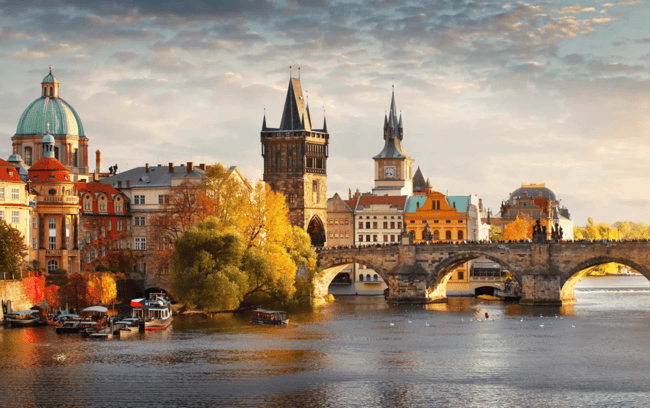
The Czech Republic (Czechia) is a small country right in the middle of Europe. It has a population of less than 11 million people. The evangelical population there is tiny—less than one percent—and religion has been declining in the country for years. Although Czechia has a rich Christian heritage going back more than a thousand years, today it is widely regarded as the most atheistic country in the world. And yet, the Czech ministry leaders I talked to this week in Poland believe the Lord is doing something in their country. Pete Lupton, leader of a THF partner organization that helps men and women escape pornography addiction, told me, “Czechia isn’t atheistic—everyone believes in something; they just don’t know what yet.” Tomas Polivka, who leads a publishing ministry based in Prague, told me he’s seeing a growing interest in Christian materials. Marek Chvatal, who runs a Czech evangelistic website, says they’re getting more hits from people looking for information about Jesus and Christianity than ever. Daniel Jokl runs Christian camps for children, and he says even non-Christian parents are sending their kids to Christian camp. Tyndale House Foundation has many partners in the Czech Republic—probably more than one might expect, given the country’s small size and small Christian presence. But this week I’ve been wondering whether by overinvesting in Czechia right now, we could actually be participating in a movement of God there that could impact generations to come. Please pray for Czech people to find Jesus!

Trend Analysis Part 3
During the month of May, I’m using one segment of the THF Weekly Briefing each week to describe and analyze a trend we’re seeing in the world of philanthropy. So far we’ve covered Trust Based Philanthropy and Celebrity Philanthropy. This week’s trend is Collaborative Philanthropy. What are others doing? Historically, foundations have been pretty secretive about their giving, but within the last decade, more and more foundations are not only sharing information but joining forces through collective giving. What does the trend mean? Researchers believe this helps to diversify grantmaking, empower marginalized voices, and extend generosity beyond financial contributions. Christian foundations are utilizing collective giving to hopefully move the needle on big issues that no single foundation could hope to meaningfully address alone. What is THF doing? You could make the argument that THF helped pioneer collective giving in the Christian foundation world. In the early 2000s, we participated in the India Leadership Study and later launched the Africa Leadership Study. Both programs brought multiple foundations together in innovative ways to fund major projects and multiply impact. Today, we are participating in two collaborative projects with nine other foundations aimed at addressing the refugee crisis in Lebanon and Egypt.
That’s it for this week’s briefing. Please send any questions, comments, and late-night meeting appointments for Czech partners to [email protected]. I send out this email resource most weeks primarily for a Tyndale audience, but you should feel free to share it with others who may be interested, inside or outside of Tyndale. Thanks for continuing to pray for and support our partners around the world.
Jeremy Taylor
President | Tyndale House Foundation
The THF Weekly Briefing provides information about significant events happening in the wide universe of Tyndale House Foundation partner organizations as well as an occasional peek behind the scenes of THF’s operations. It is available to anyone at Tyndale who’s interested in learning more about the Foundation side of the organization. Was this email forwarded to you? Contact [email protected] to be added to (or removed from) the distribution list.