


Simple and Profound
May 30, 2025Trust in God inspires praise.
I get to see a pretty wide range of human emotion in my meetings.
It has become a running joke in the THF office that people often leave in tears after meeting with me. A staff member observed years ago that I need to keep a supply of tissues in my office at all times. Why? Because the leaders I have the privilege of meeting with are passionate about their work and their mission, and that passion often manifests itself with strong emotions—even tears—when they’re talking about what God has called them to do.
Not only that, but the work these leaders do is hard, and the contexts they’re working and living in are often difficult ones. I myself have experienced the strong emotion that can result from a word of encouragement offered at just the right moment, and I try to be encouraging to others when I meet with them.
When I was in Poland last week, one of the leaders I met with was someone I had spoken with about a particular project last year. At that time, a year ago, I was excited about what she was doing with a women’s ministry, and I invited her to apply for a grant from Tyndale House Foundation. But she never did.
When I met with her again this year, I asked how the ministry was going. Through tears, she told me that the past year has been extremely difficult. It turned out to be very challenging to raise the necessary funds, and working with women in crisis was already hard. But, she said, in the end she and her partners were able scrape together everything they needed to meet the needs of women in their community.
I was surprised. “Why didn’t you apply for a grant?” I asked.
It took her a minute, but finally she said, “Because I knew that if I asked, you would help me, and I wanted to be sure this was from the Lord.”
Suddenly I was the one getting teary. This is such a wonderful example of a leader trusting the Lord to provide and not wanting to become dependent on outside funding. Later, in a meeting with several high-level leaders from multiple European countries, I recounted what this woman had said. One of the leaders abruptly raised his hands and exclaimed, “Praise the Lord!” Genuine reliance on God is an encouragement and an example to others, and the proper response is joy and thanksgiving.
My response in the moment was to thank this dear friend for her willingness to trust God. I also said, “I hope you will consider the possibility that Tyndale may be one of the ways God provides for your ministry.” I don’t know whether she will apply for a grant in the next year or not. What I do know is that even if she never receives a single dollar from THF, as long as she keeps trusting the Lord and following his call, he will supply everything she needs.
May each of us display that kind of simple faith and trust in the Lord’s provision. And may we respond with joy—and maybe even tears—when we observe faithful obedience in others.
Here’s what’s happening.

Supporting a Quiet Revival
An article published this month in Premier Christianity, a UK-based online magazine, lists ten ways Christians can respond to a report from the British Bible Society that a “quiet revival” is taking place in Great Britain. From conversations I had with leaders from across Europe last week at the European Leadership Forum, I think people are observing similar opportunities in many European countries. Among the ten suggestions listed in the Premier Christianity article are: pray first; make churches welcoming and accessible; proclaim the gospel boldly; invest in youth ministry; and focus on discipleship. At Tyndale House Foundation, we partner with organizations in the UK, across Europe, and around the world that are doing all of these things, planting seeds for more quiet—and not-so-quiet—revivals to emerge globally. As readers of the THF Weekly Briefing know, we pray regularly for our partners. We invest in church-planting and church-revitalization efforts. We fund organizations that prioritize gospel proclamation as well as orgs more oriented toward humanitarian work and holistic mission. We have many partners who focus on young people, including at-risk children. And Discipleship is one of our core grantmaking categories. It’s amazing to see what God is doing in the UK, and it’s exciting to think about how our engagement with THF partners is helping to advance the Kingdom of God around the world.

Digital Resources for Theological Education
Several years ago, the president of THF partner Theological Book Network (TBN) contacted Tyndale and several other foundations and invited us to participate in a new venture to create an online digital library providing resources for seminaries and other theological education institutions in the Majority World. Our partnership with TBN goes back to 2006, but our grants have always funded the provision of physical books for seminary libraries. So although an online digital library was an intriguing concept, at the time we opted to continue giving grants for shipping actual books. In 2024, TBN merged with THF partner ScholarLeaders, and when CEO Christopher Hays asked permission to apply for a final standalone grant for TBN’s work, the THF board decided the time had come to try something new. Our 2024 grant was nearly double the previous largest grant to TBN, and the focus was the completion and rollout of the digital tool TBN had been working on for years. At this year’s ICETE conference in Albania, ScholarLeaders formally announced that starting this summer BiblioTech, the realization of TBN’s dream, will be available for schools in nearly 150 countries. For the cost of a single book (about $15 per user), schools can access more than 500 digital books and journals in multiple languages. Many more books are available for a slightly higher cost. This is a potential game changer for theological education, as seminaries will no longer have to rely on storing and maintaining thousands of physical volumes to provide their students with access to top-quality literature and scholarship.

Trend Analysis Part 4
During the month of May, I’ve been using one segment of the THF Weekly Briefing each week to describe and analyze a trend we’re seeing in the world of philanthropy. So far we’ve covered Trust-Based Philanthropy, Celebrity Philanthropy, and Collaborative Philanthropy. This week’s trend could be called Democratized Philanthropy. What are others doing? Many foundations have an nomination process rather than an application process for grantmaking, meaning that grantees are identified by staff program officers rather than selected from a list of proposals. In an effort to reduce or eliminate barriers to entry for grantees, some foundations are moving toward a multi-nominator system. What does the trend mean? Having multiple grant officers participating in grantee evaluation and selection democratizes the nomination process so organizations aren’t dependent on the judgment of a single program officer. What is THF doing? We don’t have a nomination process exactly, but we do have a multi-reviewer system for organizations requesting access to our online application system to submit a first-time proposal. Our policy is that a single reviewer can say yes, but it takes at least two agreeing reviewers to say no. When we get to the review stage, we have multiple reviewers for every proposal. No one is denied consideration based on a single staff member’s or board member’s bias.
From the Bookshelf
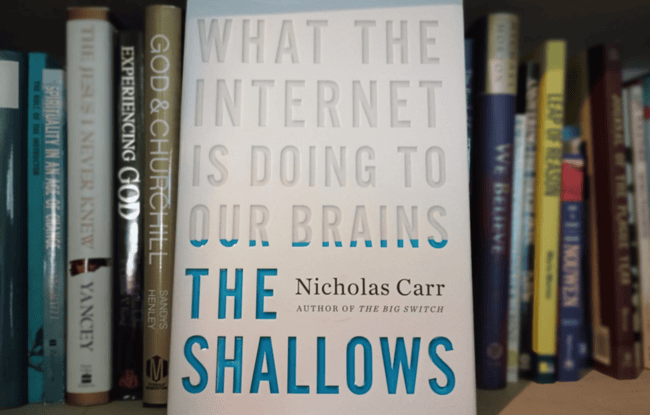
How much time do you typically spend each day thinking about neuroplasticity? Probably not very much. But have you ever wondered what effect the technology you use every day is having on your life? It turns out the way we spend our time has a direct impact on the physical makeup of our brains, which in turn has a significant impact on our habits, lifestyles, and even abilities. In The Shallows: How the Internet is Affecting Our Brains, Nicholas Carr argues that the internet is physically reshaping the way we read, think, and remember. Drawing on extensive research from neuroscience and the history of technological development going all the way back to Gutenberg, Carr suggests that our brains are literally being “rewired” as we increasingly rely on digital devices and web tools for everyday tasks. (For Carr, even the term rewired represents a shift in the way we think about our bodies; a few decades ago, no one would have used a technological metaphor for brain activity.) This book was published in 2010, when smartphones were not yet ubiquitous and AI tools like ChatGPT were still just a sci-fi dream. A lot has changed in 15 years! But the basic principles still apply. I found this book extremely challenging and compelling, and I have begun to make some changes in the way I use technology as a result of reading it. If you’re interested in an accessible but scientific analysis of current cultural realities viewed through historical lens, I strongly recommend this book.
That’s it for this week’s briefing. Please send any questions, comments, and neuroplasticity book recommendations to [email protected]. I send out this email resource most weeks primarily for a Tyndale audience, but you should feel free to share it with others who may be interested, inside or outside of Tyndale. Thanks for continuing to pray for and support our partners around the world.
Jeremy Taylor
President | Tyndale House Foundation
The THF Weekly Briefing provides information about significant events happening in the wide universe of Tyndale House Foundation partner organizations as well as an occasional peek behind the scenes of THF’s operations. It is available to anyone at Tyndale who’s interested in learning more about the Foundation side of the organization. Was this email forwarded to you? Contact [email protected] to be added to (or removed from) the distribution list.