


God in the (Cultural) Gaps
October 17, 2025Uncovering biblical themes in contemporary culture
Have you ever noticed how often the creators of our supposedly secular culture keep producing content with biblical themes?
I recently read an article in The Times of London in which John Caird, co-director of the hit musical Les Misérables, was quoted as saying, “Our first instinct was to remove all mention of God from the story throughout, but we came to realize that telling the story of Les Misérables without God being a central character would be a fruitless task.” Since the title of the article is “Les Mis has a profoundly Christian message,” it’s clear that Caird and his collaborators failed rather dramatically in their initial efforts to remove biblical themes from the classic story of redemption and forgiveness during the French Revolution.
Or consider the 1999 film The Matrix, created by Larry and Andy Wachowski (who both now go by female names). The Wachowskis are not religious and did not set out to create a Christian allegory with their story of human liberation from oppressive systems of control. Yet, whether intentionally or by accident (their comments about symbolism in interviews through the years are somewhat ambiguous), they couldn’t avoid echoing the gospel story of a promised deliverer who dies, rises again, and sets his people free.
It seems like everywhere you look, even (or maybe especially) in pop culture, authors and artists who claim to be allergic to Christianity can’t avoid dropping in biblical patterns, images, and archetypes. Even devout atheists seemingly can’t help themselves from telling and retelling the biblical story.
Look at James Cameron. The director of Titanic, Avatar, and Terminator 2 has been vocal about his opposition to organized religion of any kind. He has called it destructive and has said he has no personal faith. Yet in Titanic, a young man stands with outstretched arms and declares himself “the king of the world” before giving up his life to save another. Avatar tells the story of a human who leaves his body to physically enter another world, fulfilling prophecy and becoming the savior of an alien race. And in Terminator 2, a child savior with a saintly mother teams up with a nearly omnipotent being whose final descent into molten metal is striking not only because of his self-sacrificial act but also because of his crucifixion-like pose as he destroys himself to save the world.
Why is this? Why should biblical concepts like sin, redemption, judgment, and revelation be so embedded in our cultural vocabulary?
Or maybe a better question is, how could they not be?
Scripture is clear that creation itself is a testament to God’s glory, goodness, power, justice, and grace. Ecclesiastes 3:11 says, “God has made everything beautiful for its own time. He has planted eternity in the human heart.” That verse goes on to say that “even so, people cannot see the whole scope of God’s work from beginning to end,” but the shortcoming there lies not with God or creation but rather with humanity’s limited understanding of what should have been sufficient revelation when God “planted eternity in the human heart.”
Romans 1:19-20 says, “They know the truth about God because he has made it obvious to them. For ever since the world was created, people have seen the earth and sky. Through everything God made, they can clearly see his invisible qualities—his eternal power and divine nature. So they have no excuse for not knowing God.” Applied to modern media, one might say that content creators know the truth about God because the story of the gospel is part of universal human experience and understanding, so of course they include allegorical references to God’s character and story in their culture-shaping creations.
Our stories are filled with redemption narratives because God has placed within us an ache for restoration. That’s what French philosopher Blaise Pascal meant when he wrote in the 1600s about the “infinite abyss” in the heart of man that only God can fill. Romans 3:23 makes it clear that “everyone has sinned; we all fall short of God’s glorious standard.” At some level, we all understand that, and we long not only for redemption but for a Redeemer.
We love romance stories because God loves us. We love happy endings because the Bible depicts and promises unending joy for those who submit to Christ’s lordship. We love stories about justice and unlikely success and good triumphing over evil because those are the kinds of stories we innately understand as being about who we are and who we were created to be. Our favorite books and movies and musicals contain scene after scene of sacrifice and justice and moral reckoning because our desire for these things is part of what it means to be created in the image of God.
Our cultural narratives are filled with biblical truth—sometimes apparently by accident—because God himself is the ultimate Storyteller, and the gospel is truly “the greatest story ever told.”
Our writers and directors and actors and musicians can’t keep from telling God’s story because our deepest longings—for justice, mercy, redemption, and hope—have been written on our hearts by God himself.
Here’s what’s happening.

Religious Persecution in China
Sean Long, who spoke at Tyndale a few weeks ago, was quoted in a Christianity Today article this week about the recent arrest of Jin Mingri, senior pastor of Zion Church, a network of house churches in China. Jin was arrested along with nearly 30 other pastors and leaders in six cities across China, on charges of what Sean describes as “illegal dissemination of religious information via the internet.” On paper, arrests like this are illegal. The Chinese constitution guarantees citizens “freedom of religious belief.” But in practice, freedom of religion is all but nonexistent in China, as evidenced by the fact that Jin and the other pastors were arrested for the “crime” of streaming church services online. In both the CT article and an article by the Christian Broadcasting Network, Sean describes what’s happening in China as a new wave of persecution against Chinese believers. But at Tyndale, Sean said both he and Pastor Jin believe that with increased persecution will come a new wave of revival. Tyndale House Foundation supports several organizations operating within China to get God’s Word into the hands of pastors who don’t have Bibles and to get the message of the gospel into the hearts of people who haven’t heard it. Please pray for the release of Pastor Jin, for boldness for Chinese believers in the face of increased persecution, and for wisdom and safety for our partners who are trying to meet people’s needs while staying one step ahead of the government crackdowns.
Ministry Spotlight: SAT-7
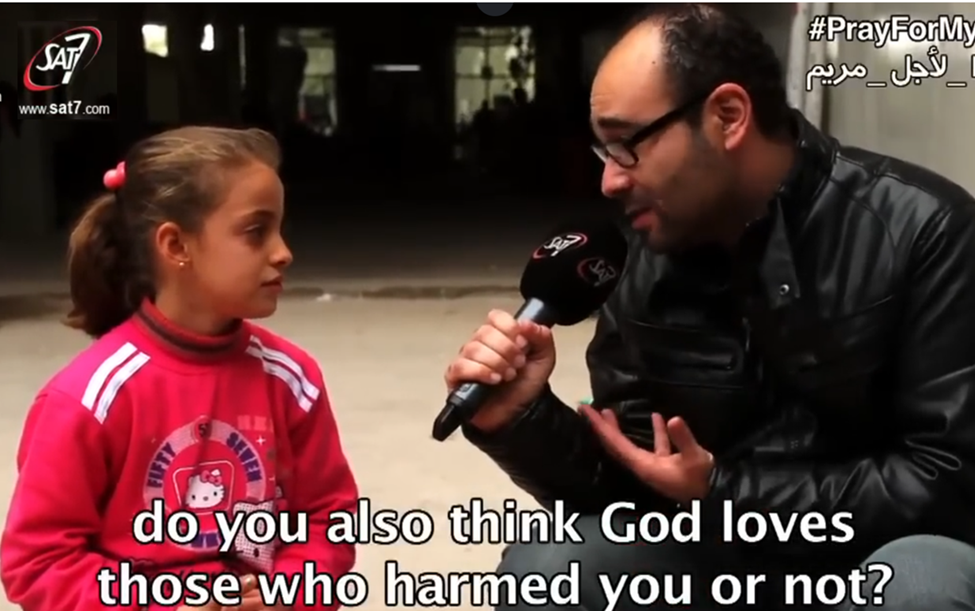
Imagine you had grown up in a land where no one ever spoke the name of Jesus. How would your life be different today if you had never heard the gospel? In 1995, a man named Terence Ascott, a media professional from the UK, decided to use technology to address exactly this situation in a part of the world where Christianity is discouraged at best and illegal at worst. Together with a coalition of Middle Eastern and international leaders, he started an Arabic Christian satellite TV network broadcasting out of Cyprus, reaching much of the Middle East and North Africa. A few years later, they added a Farsi channel and started broadcasting into Iran. In 1998, they realized the Cyprus facility wasn’t going to be sufficient to reach their growing audience, and they built a new studio in Beirut, which Tyndale House Foundation helped with financially. Later ministry expansions saw the addition of a Turkish language channel along with new production facilities in Cairo, Amman, and Istanbul. Tyndale cofounder Margaret Taylor caught the vision for SAT-7 early on and became a regular contributor of personal funds as well as THF grants, and in 2023, in celebration of THF’s 60th anniversary, the THF board awarded a special grant of $60,000 to SAT-7. Today, SAT-7 is a trusted source of evangelistic programming, theological content, children’s shows, and more, broadcasting in multiple languages, reaching millions of viewers who might otherwise have little or no access to the gospel. Last week, I received this link to a beautiful video that captures a bit of the heart of one of their programs. It features a girl named Myriam who lives in a refugee camp in Iraq. I hope you watch it—you will be encouraged by her faith in Jesus and grateful for SAT-7’s ministry impact in the region.
Blasphemy Laws a Growing Concern
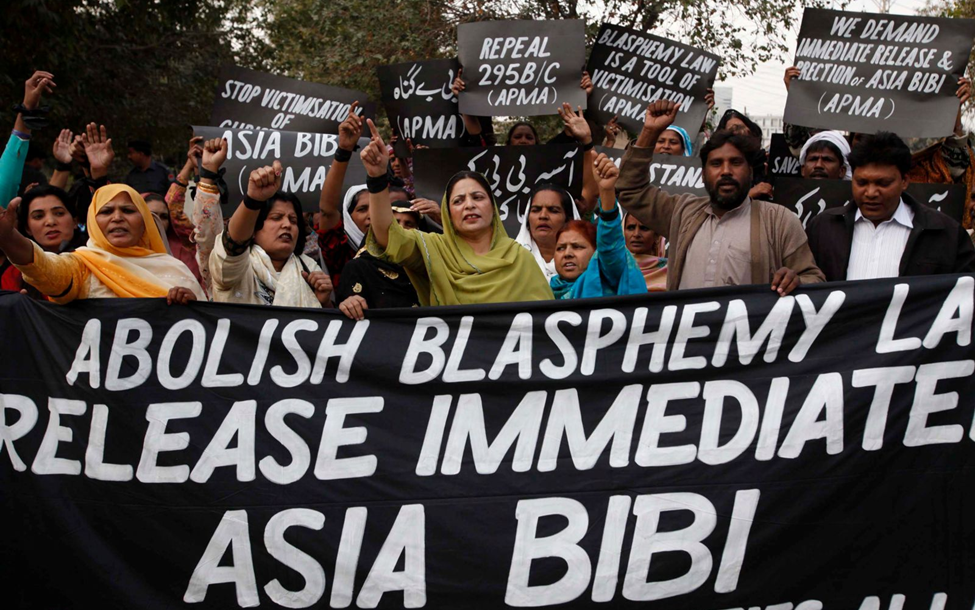
Pakistan is either the world’s fourth or fifth most populous country, depending on which census you look at. If it hasn’t overtaken Indonesia for the fourth spot, it likely will soon. That means it’s also either the world’s largest or second largest Muslim country by population, again vying with Indonesia with the top spot. With more than 255 million people and roughly a 97 percent Muslim population, Pakistan is not an easy environment for Christianity, and the nation’s blasphemy laws make it even more difficult to live there while embracing any faith other than Islam. In Pakistan, it is a criminal offense to insult Islam, the Prophet Muhammad, or the Qur’an. Penalties for blasphemy against the majority religion range from fines to life imprisonment and even the death sentence. Although the country’s constitution guarantees “freedom to profess, practice, and propagate religion,” that freedom typically does not apply to non-Muslims. Converts to Christianity, for example, often face extreme pressure from their families and communities, and if they are outspoken about their faith, they may find themselves in prison or worse. Recently, online blasphemy scams have become a major concern in Pakistan. According to a report by ReligionUnplugged, hundreds of Pakistanis have been the target of false charges of blasphemy spread on the internet in recent years. One group called Blasphemy Business, a coalition of lawyers, religious leaders, and businessmen, uses online decoys to entice young people into posting content that can be construed as blasphemous, then extorting them or even kidnapping them before turning them over to authorities to face severe punishments. Tyndale House Foundation has several partners operating in Pakistan; please pray for divine wisdom and boldness for our partners who live and work in an extremely challenging environment.
Celebrating 50 Years of Scholarship
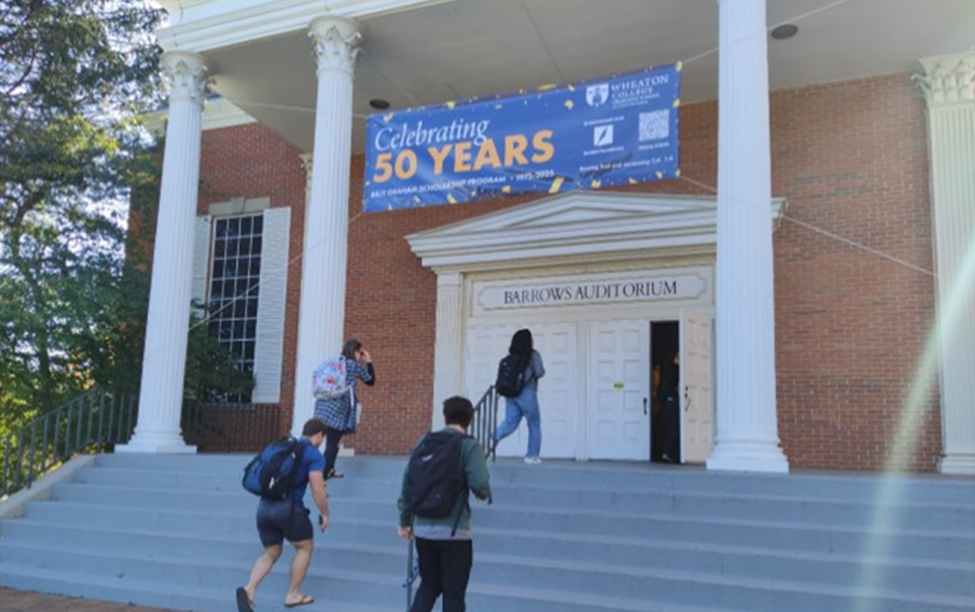
In the early 1970s, evangelist Billy Graham began working with leaders at Wheaton College to begin planning for the construction of a new building on campus that would serve as a hub for evangelism, missions, and training. Graham wanted a lasting institution to train young Christians long after his own work was finished. Graham was present at the groundbreaking of the building in 1977 and also at the dedication in 1980. (Incidentally, I was also at the dedication. I was four years old at the time and don’t remember the ceremony, but I do remember watching in awe earlier that year as the giant steeple was lifted by helicopter to the top of the huge building.) Two years before the groundbreaking, plans were already in place for a special scholarship program that would equip Christian leaders from around the world to return to their home countries and ministries better equipped and more effective than ever. The simultaneous planning was no accident; Graham and the college both wanted the Billy Graham Center to be not just a building but a gateway for global theological education and ministry preparation, and the scholarship program was the means by which that would become possible, drawing high-quality leaders and scholars from all over the world. This year marks the 50th anniversary of what became known as the Billy Graham Scholarship Program at Wheaton College. Over the past five decades, the program has supported more than 1,200 master’s-level scholars serving in over 130 nations. Tyndale House Foundation has been a frequent financial contributor to the program, sponsoring students who have gone on to lead organizations that we give grants to year after year. Earlier this year, the THF board authorized a special grant to Wheaton College in celebration of the anniversary and our partnership, and next week, several board members will participate in a reunion dinner at the college with many of the scholars who have been assisted by our funds. Please pray for the ongoing effectiveness of the scholarship program and especially for the ministry of the scholars themselves who are serving all over the world.
That’s it for this week’s briefing. Please send any questions, comments, and unintentional biblical allegories to [email protected]. Do you enjoy reading the THF Weekly Briefing? Make sure you’re subscribed to the email distribution list to get access to this resource the same day it’s published each week, and feel free to share it with others who may be interested, inside or outside of Tyndale. Thanks for continuing to pray for and support our partners around the world.
Jeremy Taylor
President | Tyndale House Foundation
The THF Weekly Briefing provides information about significant events happening in the wide universe of Tyndale House Foundation partner organizations as well as an occasional peek behind the scenes of THF’s operations. It is available to anyone who’s interested in learning more about Tyndale’s philanthropic commitments, partners, and operations. Was this email forwarded to you? Contact [email protected] to be added to (or removed from) the distribution list.