


Linguistic Ambiguity
November 14, 2025When is a word not a word?
Dictionary.com has announced its 2025 Word of the Year, and it is . . . 67.
This absolutely falls into the category of “if you know, you know.” If you looked at that “word” and read “sixty-seven,” you’re definitely not in the know. If you recognized it as “six-seven” and know how to use it in a sentence, you’re either under 25 or have kids who are teens or in their early 20s (or you’ve read this week’s “Culture Translator” email from THF partner Axis).
So, what does 67 mean, and why is this non-word the Word of the Year?
Apparently, it’s so remarkable precisely because it doesn’t mean anything. As the Dictionary.com article about the selection says, “Perhaps the most defining feature of 67 is that it’s impossible to define. It’s meaningless, ubiquitous, and nonsensical.” Yet Gen-Alphas use it all the time, to mean all kinds of things. Why? Because social media, that’s why.
Trends develop because of psychology, visibility, and social dynamics. In his book Influence: The Psychology of Persuasion, Robert Cialdini writes, “The principle of social proof says that we view a behavior as more correct in a given situation to the degree that we see others performing it.” In The Tipping Point, Malcolm Gladwell compares the way ideas spread through a population to a viral outbreak. Everett Rogers, in his book Diffusion of Innovations, calls this phenomenon “observability” and defines it as “the degree to which the results of an innovation are visible to others.”
In the internet age, observability is immediate. The moment someone posts a meme or clips a video or tweets something interesting or controversial, millions of people can see it. We no longer have to wait months or years for an idea or phrase to catch on; it happens instantaneously. Visibility leads to imitation and adoption, and suddenly you have a full-blown social contagion. It can happen with big ideas like political philosophies, and it can happen with something completely arbitrary and meaningless like this year’s Word of the Year.
What are we to make of this? Three principles come to mind for me.
First, humans are social creatures. We were made to live in communities and relationships. The Latin root of the word society means something like “the state of being companions or allies.” We were made for each other. That’s part of what it means to be created in the image of God. It’s a good thing.
Second, part of being social means that we naturally imitate each other. This can be good, like when Miriam’s song of praise went viral among the Israelite women in Exodus 15:20 or when King Hezekiah imitated David’s righteous devotion to God in 2 Kings 18:3. But it can also be destructive, especially when imitation leads us away from God’s will (like the people of Israel imitating godless nations in 2 Kings 17:15) or when imitation becomes competition (i.e., Cain and Abel in Genesis 4 or Jacob and Esau in Genesis 27).
Third, believe it or not, it’s okay not to be in on every trend. If you look at 67 and see “sixty-seven,” yes, you’re somewhere behind the bleeding edge of popular culture. My advice? Don’t sweat it. Scripture is full of admonitions to imitate Christ and not culture and to value maturity—physical (Job 12:12; Prov. 16:31) as well as spiritual (Ps. 119:100; Eph. 4:13)—over popularity.
That doesn’t mean it’s necessarily a bad thing to be in on the latest trends, provided you aren’t being led into sin. If you know what 67 means, that doesn’t make you an immature Christian. It’s useful to be culturally observant, and it’s human to be trendy. Just make sure the ultimate trend you’re into is the gospel, and the person you are imitating with your life and attitude is Christ (Eph 5:1). If you’re an influencer, influence others toward the Christian life (1 Cor. 11:1), and when you yourself are influenced, let it be by God’s Word more than TikTok.
And maybe, just maybe, next year’s Word of the Year will be something with a little more substance. Like 41. IYKYK.
Here’s what’s happening.
The Bible at Last
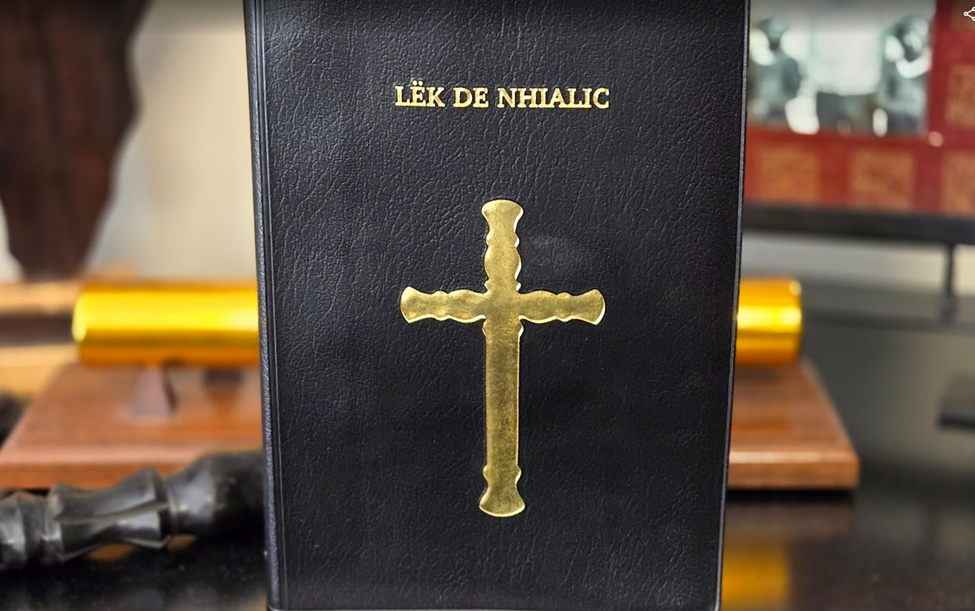
Last week, something extraordinary arrived in the Tyndale House Foundation mailbox—a copy of the Bible in a language I cannot read. Why is that so remarkable? THF started partnering with Wycliffe Bible Translators on a translation of the whole Bible into the Dinka Cam (pronounced “chahm”) language almost two decades ago. Dinka Cam is spoken by over a million people in South Sudan and is different enough from other Dinka dialects that much of its vocabulary and pronunciation would be unintelligible to neighboring groups. That’s why a Dinka Cam Bible is needed. Wycliffe linguists began working with local teams in South Sudan as early as 2005, and THF got involved in 2008. Bible translation has been a priority for the Foundation board since its founding in 1963. Our growing friendship and partnership with church leaders in South Sudan made the Dinka Cam translation project a natural one for us to participate in, and our longtime association with Wycliffe made the partnership possible. For the first time in history, Dinka Cam believers now have access to the entire Bible in their heart language. I look forward to the day, hopefully soon, when we can join our friends in South Sudan for an in-person celebration of this long-awaited joy.
Local Publishing in Global Contexts
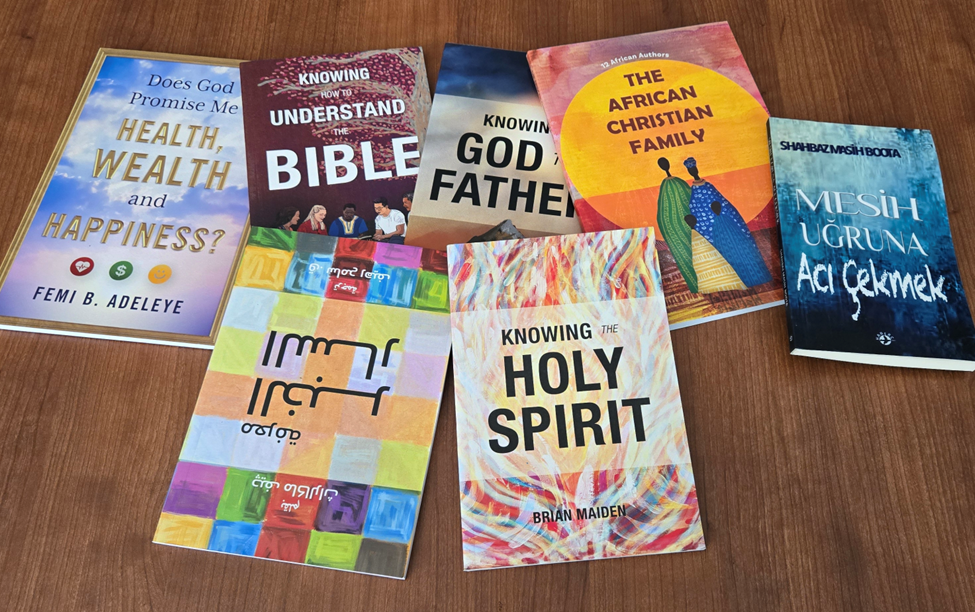
Supporting literature and publishing has been a THF priority for decades. We have worked with Christian publishers in dozens of countries, and we continue to champion Christian publishing around the globe. One publishing enterprise we’ve supported for several years is OPAL, which stands for Overseas Publishing and Literature. OPAL’s mission is to “publish affordable books and tracts by authors who speak from and to the Majority World perspective.” At Tyndale, we strongly believe that local writers, published in local languages, are best positioned to speak to the local church, so OPAL’s work aligns with our desire to platform Majority World authors. A few weeks ago, I received a packet of OPAL books, all written with a Majority World audience in mind, and several of them by African authors. These books have the potential to strengthen churches, equip parents, and help pastors across Africa navigate some of the continent’s most pressing theological and practical challenges. Please pray that these books will find an audience in Africa and beyond and that their biblical message will encourage people to walk ever more closely with Christ.

The Perfection of God’s Timing
The hardest part of foundation work is saying no to good organizations and projects, but declining proposals is a universal reality of philanthropy. Sometimes, however, we get confirmation that God can use our declinations just as easily as he can use our grants. In a Zoom meeting earlier this week, I heard something that surprised me: “If we had received this grant when we first applied for it three years ago, it would not have had nearly the impact it will have today.” For context, this was from an organization working in Madagascar to plant churches and disciple new believers. I first met the leaders several years ago, and we developed an instant rapport that has grown into a genuine friendship since. But for various reasons, we had to decline their first proposal. That was a hard letter to write, and I’m sure it was equally hard to receive. This year they submitted another proposal, and this time the answer was yes. And thanks to the groundwork the organization has laid during the past couple of years—training local leaders, strengthening church-planting systems, and expanding discipleship pathways—the impact of this grant will be greater than it would have been when we first received an application. Clearly God knows not only what he’s doing but also when partnerships should be formed for maximum Kingdom impact.
Hiya Initiative Year 1 Impact
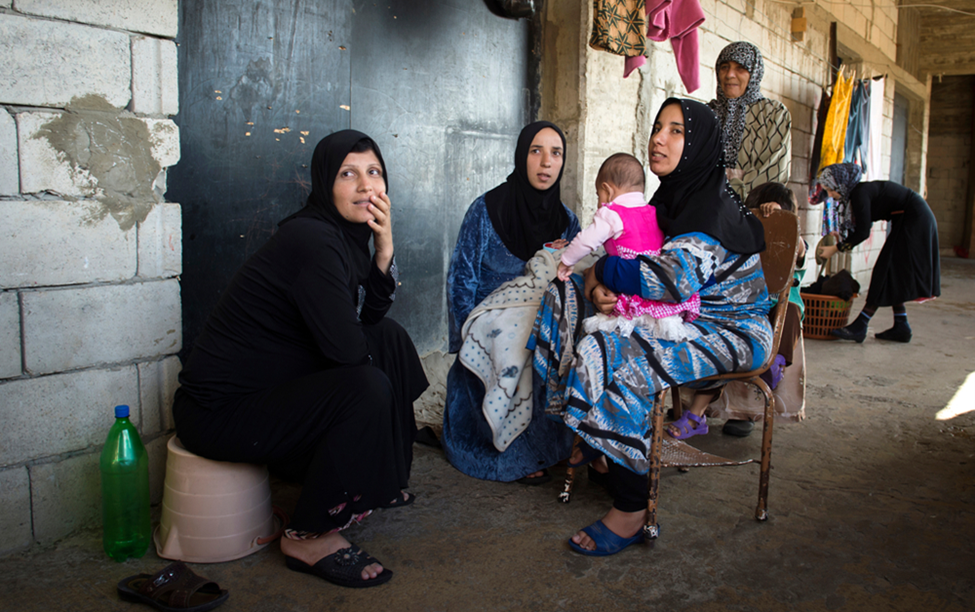
About a year and a half ago, I was contacted by another foundation leader who wondered whether Tyndale House Foundation might like to participate in a collaborative funding effort to bless refugees in Lebanon, specifically women and girls. As a foundation, we believe in following the Bible’s commands to care for the vulnerable, so I was glad to consider this request. Moreover, we’ve had great experiences working closely with other foundations in our program areas like the Africa Leadership Study, so the idea of participating in a collaborative effort was appealing. In 2024, ten foundations, including THF, pooled resources to create what came to be called the Hiya Initiative (hiya is pronounced HEE-ya and is Arabic for “she”), blessing the work of five organizations serving refugees in Lebanon. Last week, the first annual report was released, and we join with the other foundation leaders in giving thanks to God for what he has done in the lives of more than 2,000 refugee women and girls through our partners’ work. One of the women wrote, “For the first time, I feel strong enough to stand up for myself and the children.” Another wrote, “I finally understand what it means to have a personal relationship with Jesus. I am so grateful for his love.” One of the other foundation leaders wrote, “These partnerships were so refreshing, and truly, I could testify that from our love for each other, the world will recognize that Jesus has come.” Praise God for likeminded partners and for the impact that has already come from the Hiya Initiative collaboration. Please pray for the women being helped and for much more impact in the remaining two years of the project.
That’s it for this week’s briefing. Please send any questions, comments, and suggestions for next year’s Word of the Year to [email protected]. Do you enjoy reading the THF Weekly Briefing? Make sure you’re subscribed to the email distribution list to get access to this resource the same day it’s published each week, and feel free to share it with others who may be interested, inside or outside of Tyndale. Thanks for continuing to pray for and support our partners around the world.
Jeremy Taylor
President | Tyndale House Foundation
The THF Weekly Briefing provides information about significant events happening in the wide universe of Tyndale House Foundation partner organizations as well as an occasional peek behind the scenes of THF’s operations. It is available to anyone who’s interested in learning more about Tyndale’s philanthropic commitments, partners, and operations. Was this email forwarded to you? Contact [email protected] to be added to (or removed from) the distribution list.