


Leadership Insomnia
January 25, 2026What keeps you up at night?
“What keeps you up at night?”
I was asked that question once by the leader of a partner organization. We were talking about challenges and opportunities in ministry, and he suddenly broadened the conversation to talking about anxieties. But instead of asking what was worrying me or what I was afraid of, he asked about the result. “What keeps you up at night?” What is there in your life as a leader that is concerning enough to induce insomnia?
It’s a useful question.
In my experience, leaders of Christian organizations are often reticent to talk about their worries, especially to resource partners. If you’re worried about something, that might mean things aren’t going too well, and that’s not something you necessarily want to admit to someone who’s considering funding your ministry or project.
Not only that, but Christian leaders are mindful of what the Bible says about anxiety. How can we be anxious when we know that Philippians 4:6 tells us not to worry about anything but instead pray about everything? How can we dwell on our concerns when 1 Peter 5:7 says we should give all our worries and cares to God? How can we continue carrying our own burdens when Psalm 55:22 makes it clear we are to give our burdens to the Lord?
Jesus himself said in Matthew 6:34, “Don’t worry about tomorrow, for tomorrow will bring its own worries. Today’s trouble is enough for today.”
But that’s the problem, isn’t it? We do have trouble today. Business isn’t going great. Something’s going on with one of your kids. You’re overdue on an assignment. A friend is in need. You’ve received an unexpected and potentially devastating diagnosis. You’re behind on your ministry objectives. You’re not seeing the fruit you expected to see. We know we can give our concerns to the Lord, but that doesn’t make our troubles go away. Even telling yourself not to worry can be anxiety-producing. When you know you shouldn’t be anxious and yet you are, that alone can keep you up nights.
So what can we do about the inevitable anxieties of life? Simply trying not to worry is most likely counterproductive. We need a better strategy. I recommend transparency, confidence, and assistance. Here’s what I mean.
We need to be transparent and honest about what’s troubling us. As a partner, I want to know about difficult things. I want the bad news. I want to know what it is that’s running through your mind at two in the morning when sleep is elusive.
But I also want to know that our partners are confident in the truth of Scripture. The Bible doesn’t say there’s nothing in life to worry about. It does say that despite our worries, no matter how troubling our circumstances, God is sovereign and trustworthy. We are called to cast all our cares upon him not because our cares aren’t real or legitimate but because they are, and because God can take them and bear them better than we can.
We can also help each other. Galatians 6:2 says, “Share each other’s burdens, and in this way obey the law of Christ.” As partners, one of the ways we fulfill our partnership obligations is by helping one another with the tough things in our lives and ministries. But we can only help when we know what’s going on. That’s why I love asking, and being asked, “What keeps you up at night?” Not because it’s good to wallow in our anxieties but because it’s good to be reminded that whatever we’re facing, we don’t have to face it alone.
Here’s what’s happening.
Church Movements in Asia
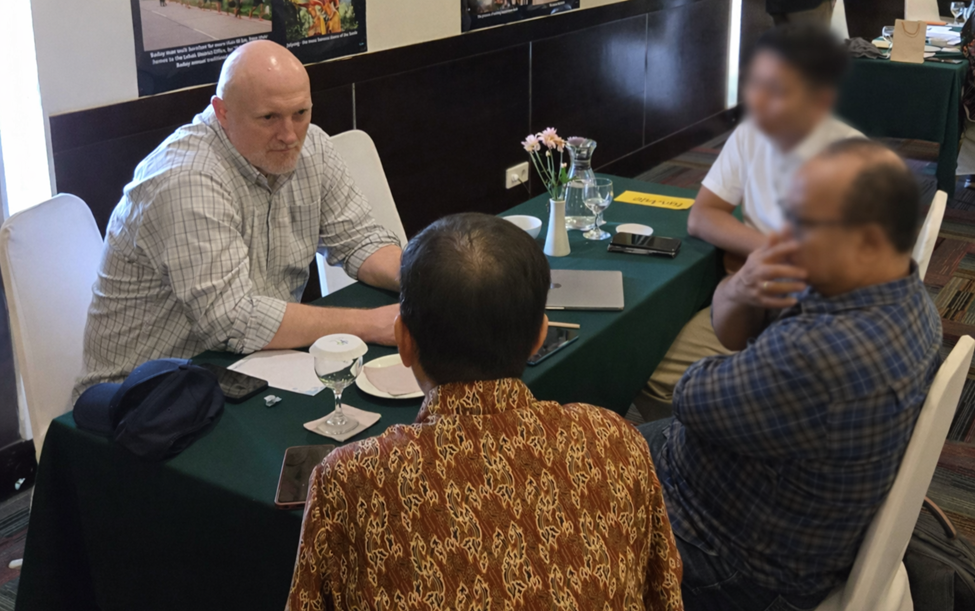
Last week I had the opportunity to travel to Southeast Asia and visit with more than a dozen indigenous-led organizations focused on using innovative techniques to bring the gospel to Unreached People Groups throughout the region. It was a short trip, in the sense that I was only on the ground for about 60 hours. It was not so short when you add up the hours I spent on airplanes and in airports—approximately 32 hours each way. Despite the grueling travel-to-ground ratio, I was grateful for the privilege of meeting with these leaders and hearing about what God is doing through their ministries. Over the course of two full days of meetings, I heard story after story of major impact in a region of the world that has historically had very limited Christian presence. One leader I met with spent two years in prison for proclaiming the gospel in a hostile context shortly after he became a believer in Jesus. Other leaders are training and sending local missionaries across cultural boundaries to plant house churches and spread the Good News. Many of the people I met with don’t speak English, so we used translators to communicate with each other. These local ministry organizations are totally committed to reaching UPGs for Christ, and because of their efforts, the number of UPGs that don’t have a single church is rapidly decreasing across the region. Please pray for these leaders, who live and work and teach and train in very difficult contexts but are totally committed to following the mission God has given them.
THF Proposal Review
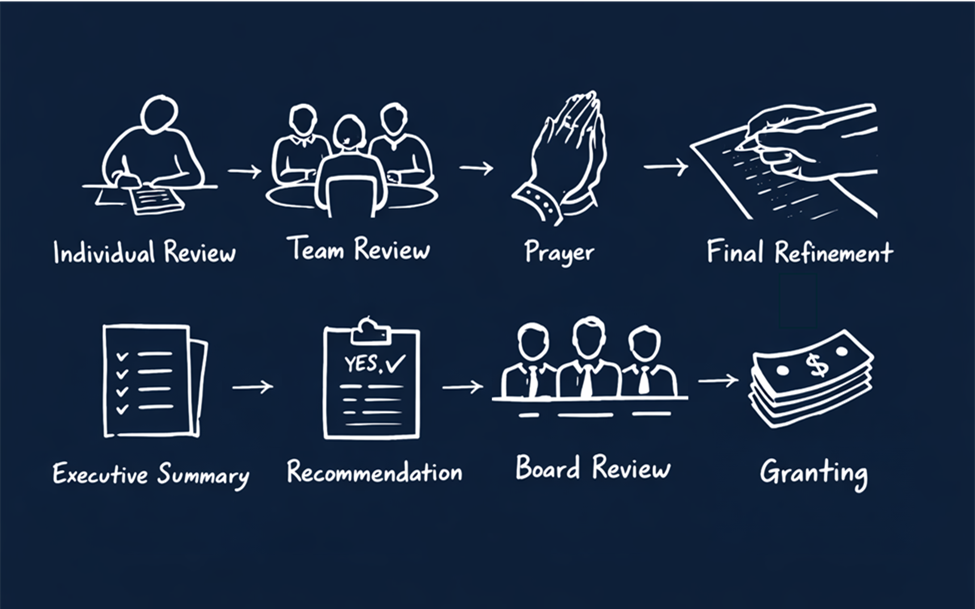
Reviewing grant proposals is one of the most important parts of foundation work, and it happens differently at every foundation. Here’s how the review process works at Tyndale. Every proposal is assigned to a THF staff person as soon as it’s submitted. That reviewer reads the proposal in detail, compiles prayer requests, writes an executive summary, and makes an initial recommendation about next steps. Each week during review season, the entire staff meets together to discuss proposals reviewed since the previous meeting and come to a consensus on whether each proposal should be sent to the board. When all the proposals for the current cycle have been reviewed individually and collectively by staff, we always end up with more positive recommendations than we have available slots for board review, so there is a third review stage where the list is refined further. The proposals that make it through the first three stages are sent to the board about a month before the board meeting, when the entire board discusses each proposal and makes a final decision about whether a grant will be awarded and what size each grant should be. Every year, we receive far more proposals than we can actually fund, so the review phase is a critical part of our stewardship, and the entire process is bathed in prayer. We are nearing the end of the first month of review for 2026, and we invite you to pray with and for us as this important work continues over the next six weeks.

Soundproof Studio Complete
In April 2025, I wrote about an organization called IDEA (a pseudonym), operating in an Asian context, using education as a platform for planting churches among Unreached People Groups. Last year THF gave a special grant to help IDEA construct a soundproof room for confidential training sessions and multimedia recording in an environment where there is significant hostility to the gospel. I had an opportunity to meet with the leaders of this organization last week when I was visiting the region. They told me the project started with a professional assessment that measured external noise levels and internal acoustic balance. The original plan was to build a single large soundproof room measuring 8 x 10 meters, but through efficient use of funds, they ended up being able to complete a second, smaller room as well and equip it for audio recording. Both rooms are now complete and have already been used for specialized training, music recording, kids’ ministry, and more. In their written report, the IDEA leaders wrote, “We are deeply grateful to Tyndale for making this vision a reality. The soundproof rooms have become a valuable asset in our mission to train and equip workers effectively for contextual ministry.”

Global Religious Persecution
Geopolitical Intelligence Services (GIS) was founded in 2011 by Prince Michael of Liechtenstein. The organization’s mission is to provide global leaders with intelligence-driven reports and forecasts on a variety of topics including politics, economy, energy, security, and technology. In November 2025, GIS published a report titled “The persecution of Christians is a global problem.” Using data from watchdog groups like Open Doors as well as GIS research, the report cited some troubling statistics. For example, more than 340 million Christians faced “significant persecution” in 2025. One in seven Christians faced persecution worldwide, including one in five Christians in Africa and two in five Christians throughout Asia. Many of the most severe cases of persecution against Christians take place in Muslim-majority countries, but Christians face major challenges in non-Muslim countries as well, including North Korea, China, India, Mexico, Cuba, and elsewhere. As the report’s title suggests, persecution is a global issue, not a regional one, and it is a moral crisis for people in every region to address. Violence against Christians and churches is a growing problem throughout the world, and it affects quite a few THF partners. Please pray for protection, endurance, and strong faith for millions of Christians across the globe who face persecution because of their faith.
That’s it for this week’s briefing. Please send any questions, comments, and tips for battling leadership insomnia to [email protected]. Do you enjoy reading the THF Weekly Briefing? Make sure you’re subscribed to the email distribution list to get access to this resource the same day it’s published each week, and feel free to share it with others who may be interested. Thanks for continuing to pray for and support our partners around the world.
Jeremy Taylor
President | Tyndale House Foundation
The THF Weekly Briefing provides information about significant events happening in the wide universe of Tyndale House Foundation partner organizations as well as an occasional peek behind the scenes of THF’s operations. It is available to anyone who’s interested in learning more about Tyndale’s philanthropic commitments, partners, and operations. Was this email forwarded to you? Contact [email protected] to be added to (or removed from) the distribution list.