

On Mission
February 11, 2026We talk a lot about mission because we care a lot about mission
We talk a lot about mission at Tyndale.
The mission statement of Tyndale House Ministries is: “To meet the spiritual needs of people, primarily through the publication of literature consistent with biblical principles and through grants to other charitable entities.”
It’s a bit of a mouthful, but it describes the two sides of Tyndale’s ministry accurately and succinctly. We publish Christian books and Bibles on the publishing side, and we give away the profits on the Foundation side. It’s simple and straightforward, as a mission statement should be, if a tad lengthy.
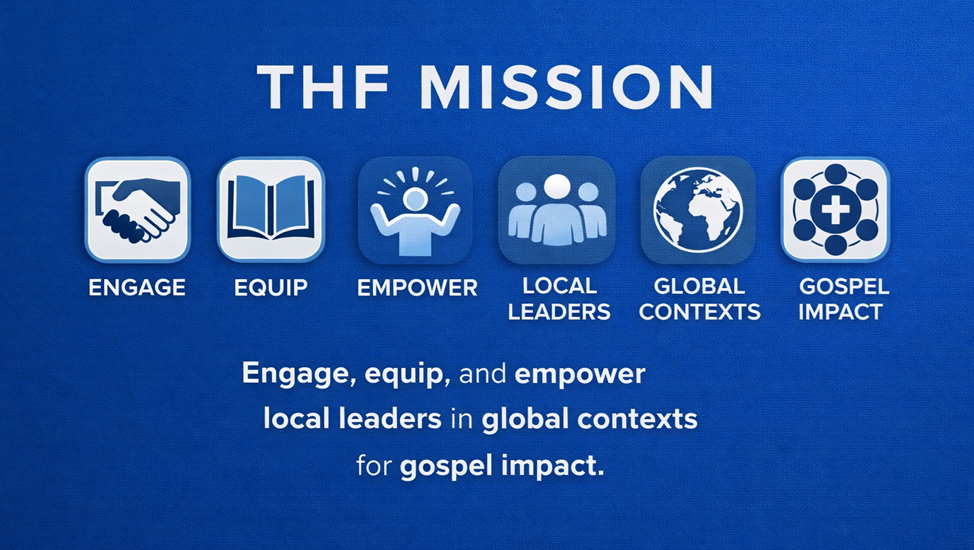
At Tyndale House Foundation, we articulate our specific mission this way: “Engage, equip, and empower local leaders in global contexts for gospel impact.” You can find this language on our website, on our literature, on our signage, even on our T-shirts. But what does it mean?
Let’s break it down item by item and start from the end with gospel impact. That’s ultimately what we’re striving to achieve with every grant we make, every partnership we form, every meeting we schedule, every site visit we arrange, every conference we attend. And what is gospel impact, precisely? Staying within the overall theme of mission, I would define it as “God’s mission moving forward as the Good News about Jesus is shared, believed, and obeyed.” That’s what we’re looking for from our partners’ work and follow-up reports, and that’s what we’re praying for as well.
What about global contexts? That is simultaneously very simple and quite complicated. It’s simple because THF has a global scope. We have partners in every region and just about every country in the world. Tyndale has Reach as one of its strategic pillars (the others are Create, Grow, and Give in case you didn’t know and are interested) because we want to reach the whole world with the whole gospel. Simple.
But it gets complicated when you add in local leaders. Who are these local leaders in global contexts?
I would contrast this phrase with its unspoken counterpart: “global leaders in local contexts.” Here’s what I mean. There are lots of great Christian organizations that operate globally but are based in the US and led by Americans. There is absolutely nothing wrong with these organizations! (Tyndale is one of them.) They are doing their part to engage the Great Commission, serve as the hands and feet of Jesus, and usher in God’s Kingdom on earth. These tend to be big organizations with big budgets and effective fundraising programs. They are global leaders operating in local contexts. I love these organizations! But in general, they’re not the organizations we look to fund as our top priority. Of course there are exceptions, but most of our grants are not going to global leaders.
Why not? Because we prioritize local leaders operating in global contexts. We look to partner with effective organizations led by leaders who live in and fully understand the context in which they’re working. We love to work with local publishers who publish local authors for the local church, indigenous-led training organizations and seminaries, national church planters in the Majority World, and locally led relief efforts. Even when we do give grants to global organizations, the people we try to invest in are the local, on-the-ground leaders who can give us the best understanding of what God is doing. We appreciate the role of professional fundraisers, but our very favorite people to cultivate relationships with are the local leaders.
What about the three “Es” of our mission—engage, equip, and empower?
We engage by actively looking for the very best local partners and impactful organizations. Our decade-long research project, the Africa Leadership Study, was focused on this very thing. We attend conferences and partner gatherings and solicit grant proposals and talk with internationally respected leaders who introduce us to other leaders, all in an effort to engage local partners who are effectively responding to God’s call. We love to respond to the invitation to “Come and see” what God is up to. That’s how we engage.
Then we equip leaders and partners by providing resources (sometimes financial, sometimes not), counsel, and connections, all in a spirit of biblical partnership. We never dictate to our grantees what they should do with THF funds; rather, we come alongside in an attitude of humility and service, asking, “How can we help?” rather than “How can you be most effective?” We ask lots of questions, listen to the answers, and stay in close contact with our partners as together we figure out a strategy for maximum impact.
Finally, we empower by releasing our partners when the time is right. We don’t tend to grant to the same organizations forever; we seek to build capacity and sustainability in our partners and then encourage them to forge other partnerships so we can move on to the next leader who’s ready to be engaged, and the cycle starts over again. What’s more, the leaders we’re engaging, equipping, and empowering go on to engage, equip, and empower others, so there’s a multiplying effect.
This is our mission! We engage, equip, and empower local leaders in global contexts for gospel impact. If this resonates with you, I invite you to join us. Pray with us for our partners. Consider reaching out with an encouraging word to the organizations you read about in the THF Weekly Briefing. Contact a THF staff person to ask how else you can get involved. You might even consider making a financial contribution to the work of Tyndale House Foundation and participate in this mission yourself.
We talk a lot about mission because we care a lot about mission. Our prayer is that the time and energy we spend carrying out our mission to engage, equip, and empower genuinely helps and encourages our partners and glorifies God in the process.
Here’s what’s happening.
Chaos Continues in Iran
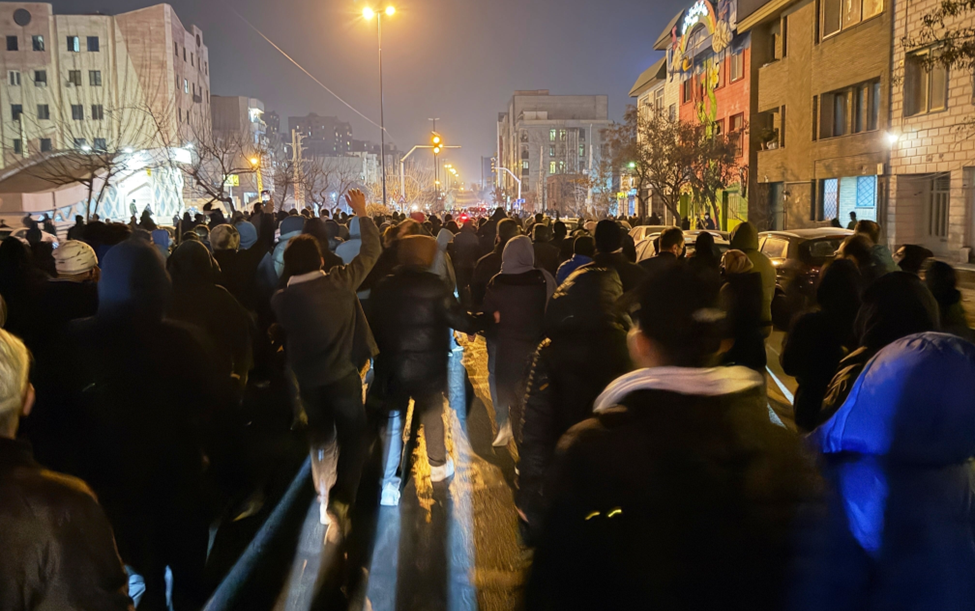
Widespread unrest in Iran continues more than a month after it began. Lana Silk, president of THF partner Transform Iran, told International Christian Concern, “Police are indiscriminately shooting into the crowds. The people try to fight back, but they are unarmed and almost entirely defenseless.” No one knows how many people have been killed by the regime in the past six weeks. Some estimates have the number in the tens of thousands. Iran’s president, Masoud Pezeshkian, who holds limited political authority, said today that he is “ashamed before the people” for the thousands of protester deaths, but activists aren’t necessarily buying the remorse. Afshon Ostovar, an expert on Iran’s Revolutionary Guard, said in an interview, “I think the regime viewed it as this was a moment of existential threat and that they could either allow it to play out and allow the protests to build . . . or they could turn out the lights, kill as many people as necessary, and hope they could get away with it. And I think that’s what they ultimately did.” The US and other governments are reportedly considering a military response. Meanwhile, Iranian Christians outside the country are deeply concerned for their family members inside Iran and are actively planning for future ministry if the regime falls. THF partner Elam Ministries has published a prayer guide for Iran. They encourage Christians to pray for comfort for thousands of families who have lost loved ones, for restored communication and economic stability, for just and righteous leaders to rise in Iran, and for wisdom and courage for the Iranian church. Please join our partners in asking God to bring peace and restoration for the people of Iran.

Is AI Coming for Your Job?
There’s no question that AI is developing extraordinarily rapidly. Three or four years ago, hardly anyone had heard of ChatGPT or Claude or Gemini or Perplexity. Today almost everyone has not only heard of these tools but used them to some degree. AI is already revolutionizing certain industries, and some experts are warning that much more disruption is on the way. Matt Shumer, CEO of HyperWrite, wrote this week in a viral post that has already been viewed 20 million times in its first 24 hours, “The people I care about deserve to hear what is coming, even if it sounds crazy. . . . The reason so many people in the industry are sounding the alarm right now is because this already happened to us. We’re not making predictions. We’re telling you what already occurred in our own jobs, and warning you that you’re next.” Shumer goes on to say, “A lot of people find comfort in the idea that certain things are safe. That AI can handle the grunt work but can’t replace human judgment, creativity, strategic thinking, empathy. I used to say this too. I’m not sure I believe it anymore.” Shumer recommends spending an hour a day using AI in order to prepare for whatever the future will look like. Freya India, writing for the “After Babel” Substack, recommends a different approach: “When everyone else is grinding out birthday messages and apologies and love letters with AI, use your voice. Stumble over your words, get them jumbled. . . . There’s never been a better time to touch the hearts of people, you just have to be human.” Probably both Shumer and India are correct. AI is very likely going to change nearly everything about the way we work, and change is going to come very rapidly. And we definitely need to hang on to our humanity in our lives, relationships, and ministry in the meantime. I encourage you to read both articles. It’s important to know what’s going on, what the potential threats are, and what a biblical perspective and response could look like. I personally am grateful that whatever an AI-driven future looks like, God holds it firmly in his hands.
God at Work in Malawi
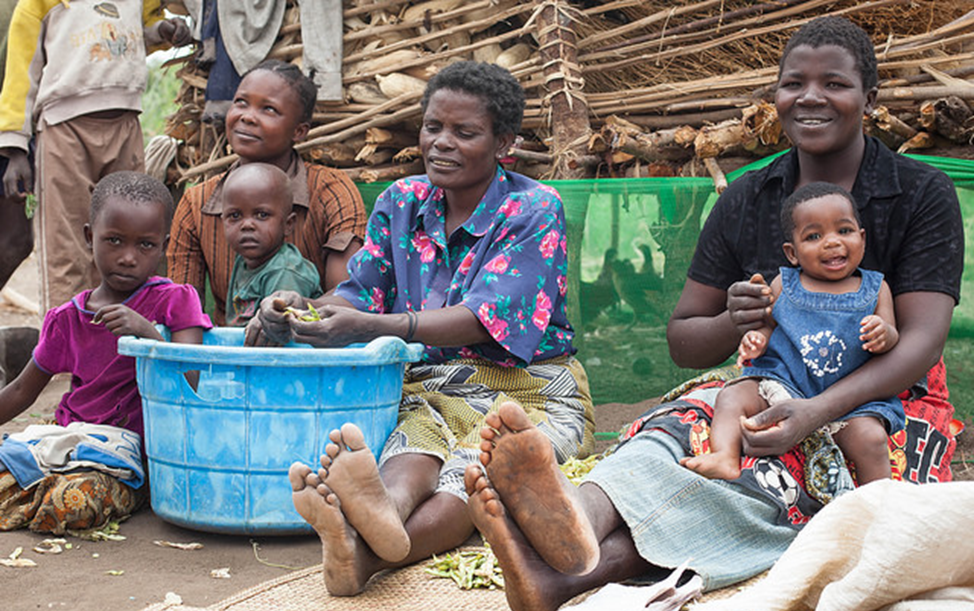
One of the great joys of Foundation work is reading follow-up reports and impact assessments and learning about what God is doing through the diligent work of our partners. This week I had the privilege of reading one of those reports from the Southeast African country of Malawi. Malawi is one of the world’s poorest countries. Most of its people live in rural villages and rely on subsistence agriculture for survival. The population is particularly vulnerable to natural disasters like droughts, floods, and cyclones, which are frequent and severe in the region. Living conditions for the majority of Malawians are difficult, as many people outside urban centers don’t have reliable access to necessities like electricity, clean water, healthcare, and education. It is in this context that THF partner Pamoza International is ministering to people’s physical and spiritual needs through the CHIEF program, focusing on Character, Health, Income, Education, and Food security. I had the privilege of spending an hour on Zoom earlier this week with Temwa Wright, Pamoza’s executive director, who told me about the impact THF funds are having in Malawi. For example, in 2025, Pamoza (the name means “together”) treated more than 4,000 cases of Malaria, provided school breakfasts to over 1,000 kids, and shared the gospel with more than 6,300 people in Malawi. Please join us in praying for Pamoza’s leaders as they strategize about how to provide people in Malawi with supplies and food that will care for their bodies and spiritual nourishment that will care for their souls.

Academic Gratitude
One of the ways we engage, equip, and empower leaders is through providing scholarship funding to select partner institutions that provide high-quality Christian education to international students. I thought you would be encouraged by seeing some of the notes we’ve received from several of these students in recent months.
- From a Rwandan student: “I am deeply appreciative of your investment in me. I am committed to working hard and making the most of this opportunity, and I hope one day I can give back to the community in a similar way.”
- From a Tanzanian student: “My heart is full of gratitude, and I am speechless about the scholarship I received from your organization. I am studying to gain more knowledge in theology and leadership skills that will help me establish the first accredited seminary in Tanzania.
- From a South African student: “I would like to express my thanks to Tyndale Foundation for your generosity. I have been experiencing the Lord showing me how what I am studying connects with my passion to go into the publishing industry.”
- From an Indonesian student: “Thank you very much for your generous support. After graduation, I hope to work in the NGO sector, serving vulnerable communities especially in areas of gender-based violence and supporting children and pregnant women.”
- From a Korean student: “You did not just donate money. You donated to my dream, vision, and vocation. You showed me what the love of Jesus is like and taught me how to reflect God’s love like a mirror.”
- From a missionary serving in the Dominican Republic: “Your willingness to support me has demonstrated God’s provision and faithfulness in my life. I am deeply grateful for you and for the way you are playing a part in helping me become equipped for what God has for me next.”
That’s it for this week’s briefing. Please send any questions, comments, and personal mission statements to [email protected]. Do you enjoy reading the THF Weekly Briefing? Make sure you’re subscribed to the email distribution list to get access to this resource the same day it’s published each week, and feel free to share it with others who may be interested. Thanks for continuing to pray for and support our partners around the world.
Jeremy Taylor
President | Tyndale House Foundation
The THF Weekly Briefing provides information about significant events happening in the wide universe of Tyndale House Foundation partner organizations as well as an occasional peek behind the scenes of THF’s operations. It is available to anyone who’s interested in learning more about Tyndale’s philanthropic commitments, partners, and operations. Was this email forwarded to you? Contact [email protected] to be added to (or removed from) the distribution list.